Don't miss our holiday offer - up to 50% OFF!
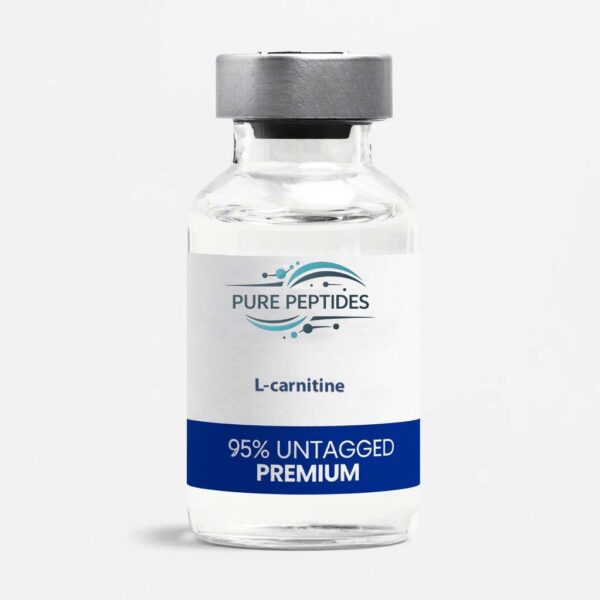
L-Carnitine – Research Chemical
Price range: £29.00 through £44.00
- Product Name: L-Carnitine
- Unit Size: Multiple sizes available
- Other Names: Levocarnitine, L-3-hydroxy-4-trimethylaminobutyrate
- Form: Solution or powder
L-Carnitine is a quaternary ammonium compound that performs one indispensable job in cellular metabolism: carrying long-chain fatty acids across the inner mitochondrial membrane. Without it those fatty acids cannot reach the enzymes that oxidize them, which makes carnitine availability a hard gate on fat oxidation rather than a modulating influence on it.
- Product Name: L-Carnitine
- Unit Size: Multiple sizes available
- Other Names: Levocarnitine, L-3-hydroxy-4-trimethylaminobutyrate
- Form: Solution or powder
L-Carnitine has been characterized across a very large published literature in bioenergetics and clinical biochemistry. Genetic deficiencies of the carnitine transporter produce documented failures of fatty acid oxidation, which is the evidence establishing the pathway as obligatory. Published work also documents the carnitine shuttle enzymes and their regulation by malonyl-CoA.
What Is L-Carnitine
L-Carnitine is a small molecule, not a peptide, supplied for laboratory research. Only the L-enantiomer is biologically active; the D form is not merely inactive but competitively interferes with the transport system, which is why stereochemical purity matters more here than for many catalogue compounds.
Mechanism of Action: How Does L-Carnitine Work
Long-chain fatty acids activated as acyl-CoA esters cannot cross the inner mitochondrial membrane. Carnitine palmitoyltransferase I, on the outer membrane, transfers the acyl group from CoA to carnitine, forming acylcarnitine. A translocase carries that across the inner membrane, and carnitine palmitoyltransferase II reverses the transfer inside, regenerating acyl-CoA within the matrix where beta-oxidation occurs. The freed carnitine returns for another cycle. Malonyl-CoA inhibits the first enzyme, which is how a cell actively synthesizing fat avoids simultaneously burning it.
- CPT-I acyl transfer → acylcarnitine formation on the outer membrane
- Translocase transport → passage across the inner membrane
- CPT-II reversal → acyl-CoA regenerated in the matrix
- Beta-oxidation access → fatty acids reach their oxidising enzymes
- Malonyl-CoA inhibition of CPT-I → synthesis and oxidation kept mutually exclusive
Core Areas of Scientific Investigation
- Fatty Acid Oxidation: L-Carnitine availability is an obligatory gate on long-chain fatty acid entry to mitochondria.
- Carnitine Shuttle Enzymology: published work characterizes CPT-I and CPT-II kinetics and malonyl-CoA regulation.
- Transporter Deficiency Models: genetic deficiencies establish the pathway as obligatory rather than modulating.
- Stereochemistry: the D form competitively interferes with transport, making enantiomeric purity experimentally consequential.
L-Carnitine Concentrations in Published Research
Concentrations reported in the published cell-culture literature are expressed in micromolar to millimolar ranges in medium, reflecting physiological tissue concentrations in the same range. Animal and human studies report milligrams per kilogram or grams daily. These are published parameters of completed experiments. They are not a recommendation, and no administration protocol is supplied with this product.
Reported Results in Preclinical Models
Published work documents failed fatty acid oxidation in transporter-deficiency models, alongside characterized kinetics for the shuttle enzymes. Results in one model may not translate to another.
Handling and Storage
Supplied for laboratory research in solution or powder form depending on the preparation ordered. As a small molecule it requires no reconstitution workflow of the kind used for lyophilized peptides.
Carnitine is markedly hygroscopic in powder form, taking up atmospheric moisture readily, so containers should be equilibrated to ambient laboratory temperature before opening and closed promptly. Store sealed, cool and protected from light.
Legal and Safety Information
All Pure Peptides products, including L-Carnitine, are sold exclusively for scientific and research purposes. This product is a laboratory reference standard for in vitro and animal research applications. It is not a dietary supplement, medical food, cosmetic, or drug. It has not been evaluated by the Food and Drug Administration (FDA) and is not approved for therapeutic, diagnostic, or recreational human consumption. Enquiries regarding human consumption cannot be answered. Any use outside an authorized laboratory environment is strictly prohibited.
Technical Data
| Identification | |
| Molecular Class | Quaternary ammonium compound (small molecule) |
| Physical and Chemical Properties | |
| Physical Appearance | White crystalline powder or clear solution |
| Form | Solution or powder as supplied |
| Solubility | Readily water soluble; hygroscopic |
| Recommended Solvent | Aqueous buffer |
| Research Use and Safety | |
| Caution | Research use only / Not for human or veterinary use |
| Storage, Handling and Stability | |
| Storage Temperature (lyophilized) | Store sealed and cool; protect from moisture |
| Storage Temperature (reconstituted) | Prepare fresh solutions |
| Light Sensitivity | Protect from light |
Why Choose Pure Peptides Reference Compounds
When executing high-level metabolic research, compounding variables can compromise data integrity. We isolate and eliminate those variables.
- Verified High Purity: every batch is analyzed by high-performance liquid chromatography, with the purity profile recorded against the lot.
- Structural Stability: the synthesis protocol yields stable chains that resist premature degradation under the recommended storage conditions.
- Temperature-Shielded Logistics: shipped in insulated packaging to preserve structural integrity in transit to the receiving laboratory.
- Full Batch Traceability: lot number and manufacture date are recorded for every vial.
Suggested Research Combinations
- AICAR — a direct AMPK activator that relieves malonyl-CoA inhibition of the shuttle, the upstream regulatory counterpart.
- SS-31 — a mitochondrial inner-membrane peptide, run in parallel in bioenergetics designs.
- Lipo-C — a compounded lipotropic preparation containing related constituents, the formulation comparator.
Frequently Asked Questions
Why does the L form matter?
Only the L-enantiomer is biologically active. The D form is not merely inactive but competitively interferes with the transport system, so stereochemical purity is experimentally consequential here.
What is the carnitine shuttle?
The enzyme system that moves long-chain fatty acids into mitochondria. CPT-I attaches the acyl group to carnitine outside, a translocase carries it across, and CPT-II reverses the transfer inside where beta-oxidation occurs.
Why is it described as an obligatory gate?
Long-chain fatty acids cannot cross the inner mitochondrial membrane without it. Genetic transporter deficiencies produce documented failures of fatty acid oxidation, establishing the pathway as required rather than merely modulating.
How should it be stored?
Store sealed, cool and protected from light. Powder preparations are markedly hygroscopic, so containers should reach ambient laboratory temperature before opening and be closed promptly.
Is this product approved for human use?
No. This material is a laboratory reference standard supplied strictly for in vitro and preclinical research. It has not been evaluated by the Food and Drug Administration and is not approved for therapeutic, diagnostic, or human application of any kind.
Regulatory Status
L-Carnitine is supplied strictly for in vitro and preclinical research purposes. Its use is considered experimental; long-term safety and efficacy in humans have not been established. All referenced findings derive from published preclinical and clinical research, and results in one model may not translate to another.
| Peptides | 1200mg*1vials, 600mg*1vials |
|---|
Related products
-
AICAR – Research Chemical
£49.00 -
Cagrilintide – Research Grade Peptide
Price range: £89.00 through £179.00Select options This product has multiple variants. The options may be chosen on the product page -
AOD-9604 – Research Grade Peptide
Price range: £44.00 through £129.00Select options This product has multiple variants. The options may be chosen on the product page -
NAD+ – Research Chemical
Price range: £39.00 through £128.00Select options This product has multiple variants. The options may be chosen on the product page
Reviews
There are no reviews yet.