Don't miss our holiday offer - up to 50% OFF!
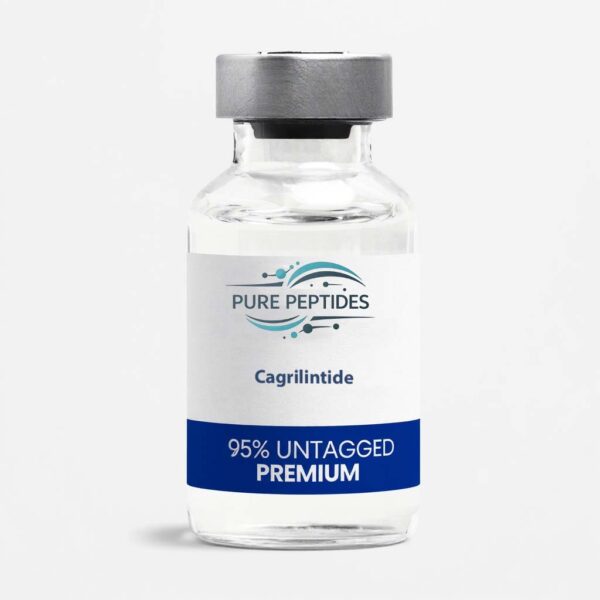
Cagrilintide – Research Grade Peptide
Price range: £89.00 through £179.00
Cagrilintide is a long-acting amylin analogue studied for its role in satiety signaling, gastric motility, and energy balance. The acylated 39-amino-acid peptide engages the amylin receptor family AMY1–AMY3, heterodimeric complexes formed between the calcitonin receptor and receptor activity-modifying proteins. Cagrilintide is investigated both as a single agent and in combination with GLP-1 receptor agonists, where its non-overlapping mechanism makes it a frequent subject of additive-effect research.
- Product Name: Cagrilintide
- Unit Size: Multiple vial sizes available
- CAS: 2381024-26-4
- Other Names: Cagrilintide, AM833
- Form: Lyophilized solid
The compound has been characterized in a Phase 2 randomized trial published in The Lancet in 2021, which documented a mean body weight reduction of 10.8% at 26 weeks in the highest-dose monotherapy arm, against 3.0% in the placebo arm. Preclinical work in rodent models has documented reduced food intake and delayed gastric emptying following amylin receptor agonism, effects attenuated by amylin receptor antagonists.
What Is Cagrilintide
It is a synthetic analogue of human amylin, a 37-amino-acid hormone co-secreted with insulin from pancreatic beta cells. The analogue is engineered for solubility and stability, since native human amylin aggregates readily into amyloid fibrils, and is fatty-acid conjugated to extend its circulating half-life. It is supplied as a lyophilized solid for laboratory research.
Mechanism of Action: How Does Cagrilintide Work
Cagrilintide binds amylin receptors AMY1–AMY3, which form when the calcitonin receptor dimerizes with receptor activity-modifying proteins RAMP1, RAMP2, or RAMP3. These receptors are densely expressed in the area postrema, a circumventricular brainstem structure lacking a complete blood-brain barrier, which makes it accessible to circulating peptides. Receptor engagement at this site is associated in the literature with reduced meal size and delayed gastric emptying in animal models. Structural modification to resist amyloid aggregation, combined with fatty-acid acylation and consequent albumin binding, produces the extended half-life that supports the weekly dosing intervals used in published trial protocols.
- Calcitonin receptor + RAMP dimerization → AMY1–AMY3 receptor formation
- Area postrema receptor engagement → brainstem satiety signaling
- Amylin receptor agonism → delayed gastric emptying in animal models
- Anti-aggregation modification → solubility and formulation stability
- Fatty-acid acylation → albumin binding and extended half-life
Core Areas of Scientific Investigation
- Amylin Receptor Subtype Selectivity: the compound is used to probe the relative contribution of AMY1, AMY2, and AMY3 receptors, and to distinguish amylin signaling from calcitonin receptor signaling.
- Brainstem Satiety Circuits: researchers investigate area postrema and nucleus tractus solitarius populations that mediate meal termination.
- Combination Pharmacology: studies assess whether amylin and incretin pathways produce additive effects on energy intake when co-administered.
- Peptide Aggregation Chemistry: the analogue is studied as a model for engineering amyloidogenic peptides into stable, soluble research articles.
Cagrilintide Dosage in Published Research
Doses reported in the published clinical literature range from 0.3 mg to 4.5 mg administered subcutaneously once weekly in adult human cohorts, with the 4.5 mg arm producing the largest documented mean weight reduction in the Phase 2 program. These figures are recorded as published parameters of completed experiments. They are not a recommendation, and no administration protocol is supplied with this product.
Adverse Events Reported in the Literature
Gastrointestinal events, predominantly nausea, were the most frequently reported adverse events in the published trial arms and were characterized as mostly mild to moderate. Injection-site reactions were also recorded. These are reported findings from the published literature, not safety guidance for this product.
Usage, Reconstitution and Storage
Supplied as a lyophilized solid to preserve stability and to limit the aggregation behavior characteristic of amylin-family peptides. Reconstituted material has a materially shorter stability window than the sealed vial.
Pure Peptides recommends bacteriostatic water as the reconstitution solvent, and that both the lyophilized material and the chosen solvent be allowed to reach ambient laboratory temperature before reconstitution. This helps maintain structural integrity during dissolution. Reconstitution solutions and a peptide storage case are supplied separately.
| Peptides | 10mg*10vials, 5mg*10vials |
|---|
Related products
-
SS-31 – Research Grade Peptide
Price range: £78.00 through £299.00Select options This product has multiple variants. The options may be chosen on the product page -
Survodutide – Research Grade Peptide
£228.00Select options This product has multiple variants. The options may be chosen on the product page -
Tirzepatide Pen – Research Grade Peptide
Price range: £27.00 through £54.00Select options This product has multiple variants. The options may be chosen on the product page -
Semaglutide – Research Grade Peptide
Price range: £28.00 through £95.00Select options This product has multiple variants. The options may be chosen on the product page
Reviews
There are no reviews yet.